


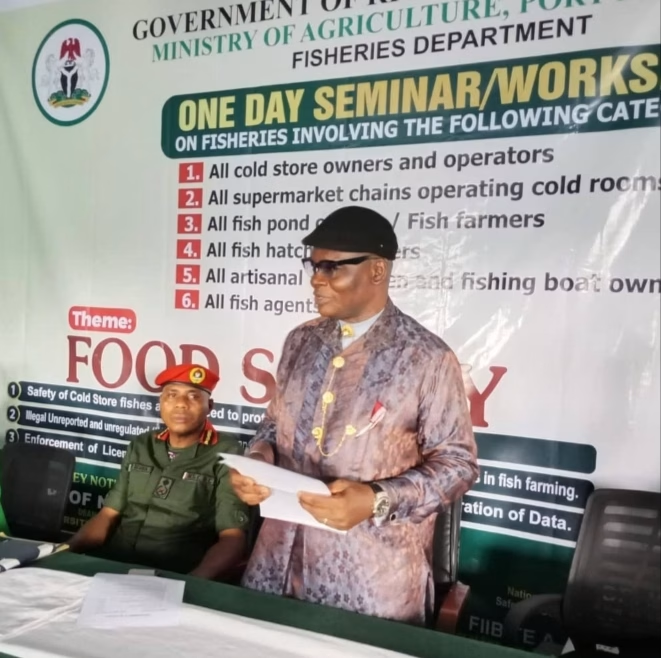
The Rivers State Government has called on cold room owners and operators, supermarkets, fish pond owners, fish farmers and fish agents to provide accurate information to the government to strengthen regulation and promote food safety in the state.
The Permanent Secretary, Rivers State Ministry of Agriculture, Mercy Dagogo Iboroma, made the call at a one-day fisheries seminar/workshop with the theme, “Food Safety”, facilitated by J. Lawrence International Nominees Ltd. and held at the Rivers State Veterinary Hospital and Diagnostic Laboratory, Port Harcourt.
Iboroma, who was represented by the Director of Finance and Accounts, John Israel, said food security could not be achieved without food safety.
She urged participants and other stakeholders to identify the causes of food contamination in the state and proffer practical solutions to safeguard public health.
The Permanent Secretary explained that the Ministry’s regulatory activities were not aimed at generating levies or treating complaints as mere formalities, but at identifying areas of weak coordination and addressing them.
She assured operators that the Ministry was committed to providing clearer explanations, and ensure consistency in its regulatory processes, whil giving stakeholders a fair opportunity to comply with established standards.
According to her, the regulation of farmers was not the responsibility of a single agency, noting that the Ministry works with the Nigeria Security and Civil Defence Corps (NSCDC) to ensure compliance with food safety standards.
She said the workshop was designed to address the specific challenges faced by operators and stakeholders rather than treating their concerns from a general perspective.
“Tell the resource persons where farming is unclear, where administration has been unhelpful, and where paperwork does not match your business. That is the kind of information the Ministry acts on. We are here to learn, relearn and unlearn”, she said.
In his keynote address, the Dean, Faculty of Agriculture, University of Port Harcourt, Prof. Nene Jamabo, expressed concern over poor hygiene and quality control in the handling of fish, warning that such practices could pose serious health risks.
He stressed the importance of producing safe fish, noting that healthy food contributes to a healthy population.
Jamabo urged cold room and supermarket operators to maintain strict temperature records and observe proper hygiene practices.
He also called for regular inspections by the state inspection team, stressing that data generated from such inspections should be promptly reported, shared and acted upon.
He condemned the use of harmful chemicals by fishermen, particularly artisanal fishers, as well as illegal, unreported and unregulated (IUU) fishing practices, including the use of inappropriate fishing nets, harvesting undersized fish and fishing throughout the year.
He called for an end to such practices and advocated stronger collaboration between the Ministry of Agriculture and relevant agencies to improve food safety.
The don also called for regular inspections and pledged the support of the University of Port Harcourt through its laboratory, where stakeholders could be trained in basic hygiene practices.
He added that university researchers could assist in testing fish for harmful chemicals.
In a presentation titled “Safety of Cold Store Fishes and the Need to Protect Consumers in the State”, the National President of the Catfish and Allied Fish Farmers Association of Nigeria, Dr. M.Y. Momoh, represented by Chief Oyekuotor Isaac Ukwe of the Department of Fishery and Aquatic Environment, Faculty of Agriculture, Rivers State University, explained that fish contamination was not limited to temperature control.
He said contamination could occur before freezing, during handling and transportation, or at the point of sale.
Momoh, therefore, called for concerted action by government, business operators and consumers to protect public health.
He urged government to establish and enforce appropriate standards, monitor activities and ensure compliance.
He also advised consumers to make informed choices, check safety labels, handle and cook fish properly, maintain appropriate storage and transportation conditions, and report food safety concerns.
Momoh also urged the health sector to strengthen the detection and response to food-borne diseases, provide public health guidance and support community surveillance.
“The goal is not just to keep fish frozen, but to keep people safe”, he said.
Also speaking on the topic, “Illegal, Unreported and Unregulated Fishing in Artisanal Fisheries and the Use of Harmful Chemicals”, the Head of Fisheries Department, Ministry of Agriculture, Mr. Fi-Ibite Adokiye, decried the activities of foreign nationals in the fishing sector and the harvesting of juvenile fish by some artisanal fishermen.
He said the practice of harvesting small fish destroys juveniles and affects the natural multiplication of fish stocks.
Adokiye urged fishers to desist from such practices, warning that Agro-Rangers and other relevant law enforcement officers would be involved in efforts to curb the menace.
The Head of Department, Agro-Rangers, Nigeria Security and Civil Defence Corps, Rivers State Command, DCC Odiba F. Boyi, who spoke on “Enforcement of License and Inspection by Relevant State Actors and Generation of Data”, said food security was meaningless without food safety.
He noted that unsafe food could result in illness, death and economic losses.
According to him, effective licensing and regular inspection are necessary to check non-compliance, protect farmers and agricultural investments, promote peaceful coexistence among farmers and help resolve conflicts.
Boyi called for stronger collaboration among relevant agencies, including the National Agency for Food and Drug Administration and Control (NAFDAC), state and local governments.
He also advocated continuous public enlightenment and the use of mobile courts to facilitate prompt compliance with regulations.
He urged stakeholders to provide timely and relevant information to appropriate security authorities, stressing that inspection should always generate useful data.
“Without inspection, a licence is just a piece of paper”, he said.
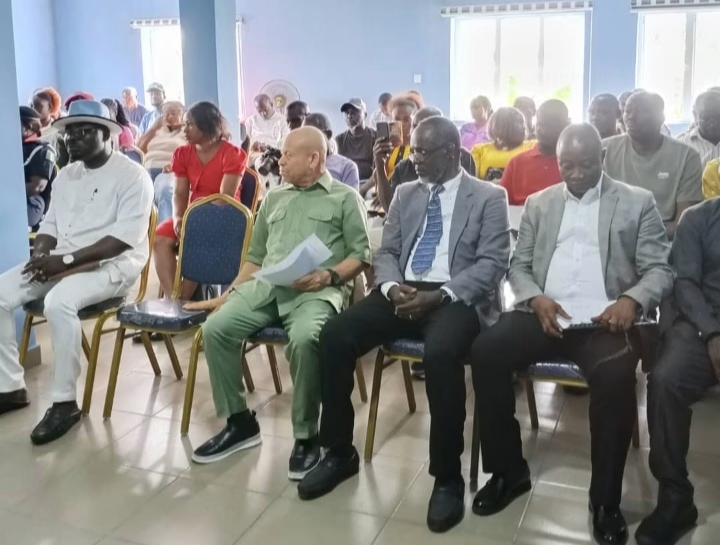
The seminar featured a breakout session involving cold room owners and operators, fish farmers, artisanal fishers and boat owners.
During the session, participants identified several challenges affecting their operations, including inadequate electricity supply, limited access to financial support, insufficient information and enlightenment, the need for greater collaboration, inadequate knowledge of specific inspection laws, and the need for government assistance in empowerment programmes and the provision of schools and recreational facilities in fishing settlements.
In her vote of thanks, the Chairman of the event and Director of Fisheries, Tomma Oruye, appreciated the participants, stakeholders and facilitators, J. Lawrence International Nominees Ltd, for their contributions to the success of the programme.
Oruye urged stakeholders to ensure that food produced, processed, transported, sold and consumed in the state is safe.
She stressed that food safety was not an option but a shared responsibility, and assured participants that the Ministry would organise similar programmes to further enlighten farmers and address challenges affecting the sector.
The workshop ended with the presentation of certificates to participating farmers.
- Anumaka is the Information/Public Relations Officer, Ministry of Agriculture.