


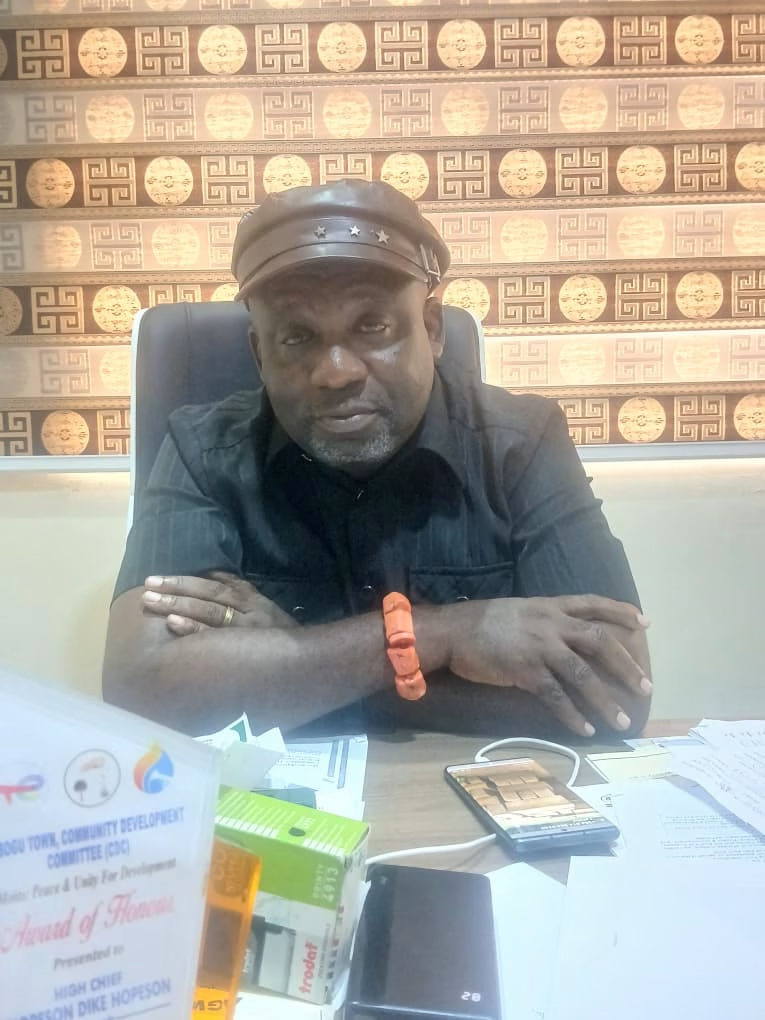
As the pioneer Chairman of the Board of Trustees of the Obagi Host Communities Development Trust (HCDT), established under the Petroleum Industry Act (PIA) 2021, Chief Dike Hopeson Dike has emerged as one of the leading voices driving grassroots transformation in Rivers State’s oil-producing communities. Under his leadership, the Trust has recorded significant strides in infrastructure development, healthcare delivery, education, youth empowerment and industrialization across communities within OML 58. In this interview, he reflects on the challenges of building a development institution from scratch and the impact of the PIA on host communities.
The Obagi HCDT has been in the news for championing development. How exactly have you been able to do this?
First, when, as a pioneer board chairman where there was no structure, I was very conscious and deliberate with a mindset that my people are yearning for development. I moved round the communities and saw decades of failed infrastructure—schools that were so bad, roads, even the water units, the health centres. We had a very bad history where there was no reference to our communities in terms of infrastructure, in terms of good governance, in terms of accountability.
So, I was conscious of the fact that my leadership from the beginning had a lot of challenges. Some people believed at then that I was too young to manage the affairs of Obagi HCDT. They believed it should be people who were retired from Shell, Agip, Total, NDDC. But I was well prepared for the job and I was well cut out for it, and I didn’t want to give an excuse.
So, by the time I began, the first thing that I did was to set up a structure that doesn’t have ethnic coloration. I didn’t want to know where you are coming from; I just wanted to hire the best, put them as a team, and we came here, sat down and developed our blueprints, our target, our vision. And I was able to put it in black and white as the document that will guide the day-to-day operation of this place.
Luckily for me, I had the support of my settlor, TotalEnergies EP, who gave me all the support, understanding where I was coming from, believing in the vision that I have shared with them during the interview for the selection of the board. And I also want to thank my colleague board members for tolerating me, because I’m an unusual character that wants things to be done right. So in doing that, you’re going to offend a lot of interests. But they tolerated me, the management committee, the advisory committee, even the larger stakeholders were able to start sharing in the vision. The moment the people start seeing results, seeing evidence, they begin to trust in the system. There was a lot of anxiety, even from the side of the company and the communities, whether this process can work. But thank God, we were able to make it work. We were able to design the process, design the structures that we put here, and to the glory of God, we are here today. Obagi HCDT, with its modest achievements, has been able to transform lives, transform communities. We have physical evidence to show for the money we have received, and we are always very available to give account for whatever actions we have taken, and it’s part of our responsibility here.
Would you say that the passage of the PIA by the National Assembly is justified?
Yes, I think the Niger Delta people, especially the Egi people where I come from, are supposed to honor the late President Buhari. Buhari was the best thing that happened to us, because by the passage and the immediate signing of the PIA, it became an instrument for an accelerated development and empowerment of our people. So, for me, it was and it is still the best thing that has happened to the oil-bearing communities, especially the Egi OML 58 where I come from.
One outstanding thing about the execution of projects you are executing is that it’s not just a one-man project. Somebody does the building, another handles the painting, another person does the wiring, another person does the supply of furniture, and all of that. What necessitated this decision?
First, I served as Egi Oil and Gas Chairman, who was saddled with the responsibility of implementing MOU for like five years. So, I already understand the challenges of project delivery, and was very, very careful in designing our contracting and our payments policy. First, one of the issues why projects had failed during the MOU regime was payment of mobilization. I realized that very early and decided that I’m not going to pay mobilization. So, what it means is that until you execute that project to the standard and we certify it, what we are just holding is paper, it does not translate to Naira and Kobo.
And we also understand that one of the things that has bred community crisis was centralizing contract award to the hands of few individuals who were being seen as untouchables in their communities. And I decided I was going to shake the table and change the status quo. So, what was the definition? It was that we stopped selective bidding, and we are now doing open bidding, which I call open accountability. If I have 10 jobs in my community or in any community, we publish it in the community platform, they print and paste. So, everybody has the same equal opportunity to participate.
So, what we have also thought is that if this building is going to cost me 500 million and I give it to one individual, what I have made is that I have enslaved the community in the hands of one man. And because I needed to give the people financial freedom, we designed that these projects will be unbundled where, at every time, it can be up to 10 to 15 persons that will benefit. So, because even when the PO is in your hand, because you cannot invoice because there is no… we did not perform advance payment like mobilization. So, we pay as you go. If I award you a job and you do 10%, you come back, I pay you the 10%. So, it’s graduating when you finish. So, you won’t owe me. So, if you do like 30% and I pay you for 30% and abandon the road, it’s easier for me to quickly re-award the contract to another person, and we use the available 70% to execute the job. So, this is where the strategic institutionalization that we did here and this is where the framework that validated what we did and has given us these results.
There are over 60 communities or so in this OML 58. How have you been able to manage all contesting interests?
Honesty. First, the community realized that I have not benefited one kobo from their resources. First, let me tell you something. The way the HCDT is structured, there is no pool money. Every money belongs to a community. I’ll show you a document. If you look at this document now, these are all the communities under the HCDT. So, every community has… this was money received in 2023, 2024, 2025. This is the total value of money, actual expenditure, committed cost, assigned cost, and available funds. So, at every time, the communities are aware that this is the money. Because the law required that for every year, we need to present… the management committee will prepare budget, present it, and the board will approve it. So, it becomes a working document. So, for every year, we prepare budget, they finish and bring to us for approval. So, we are guided for you to know this is the money that is your money.
So, in that expenditure, every community… before now, when we started, there was a needs assessment by each community where every community decides the projects that suit them and submitted it here. We worked on it, and it now forms the 5-year Community Development Plan, which we submitted to our settlor, Total, they transmitted to NUPRC, which is the supervisory Commission, and it was adopted as a working document. So, for whatever we do, it’s within the legal framework of what your community submitted and the available resources in your community.
So, first of all, the community start building confidence, having confidence that the Trust is not interfering. I have not—and I say it on record, and I challenge any community—benefited N1,000 from any contracting process from any community since I became a board chairman. So, before now, the era of sharing proceeds from contract was the order of the day. So, now everybody is comfortable knowing that if you are lucky to win a job here, you’re comfortable, nobody is sharing contract gain. So, people build confidence, we can trust this young man. This young man has made himself available for service. This young man has given us reason to have confidence in him. So, this is why the people trust and believe that we have performed credibly well, and we can defend whatever action… We are not infallible, when we make mistakes, we take responsibility because we are human, we are mere mortals.
So, in essence, what you’re saying is that each community in the Obagi HCDT has its own money. So, each community knows…?
Yes, how much they have. And every year, the moment their allocation comes, and the law says the settlor, which is Total, will provide a matrix. The moment that matrix is provided, we apply it, so every community knows what they have based on the facilities that is in their community. So, from day one, you already know how much you have. So, as we are spending, you know what we are spending. So, it’s difficult for somebody to even remove 1,000 from any community fund, because the community will interrogate you. They will ask questions, What have you used this fund for?
Okay, so the idea of taking money from Community A to Community B…
You cannot. You can’t use money made for Ogbogu for Akabuka. You can’t use money made for Obite for Ede. So, everybody will only spend what it has. And this money is not equal. Some people have billion, some people have 20 million, because those are just impacted communities, they are not original host communities, but by the provisions of the law, they were just impacted to be co-opted into the HCDT.
There are people undergoing training in diverse backgrounds and all the rest. What is the criteria for selection?
Exam. So, at every given year, when we look at the budget for each community, and if we say Community A has 10 people for scholarship and 5 people for skill, they write an exam. So, the best 10 and the best 5 are selected. We don’t know, we… In fact, what we have done to avoid complicity, because we are human, was to outsource it to an independent consultant who do not know anybody. So, the person does not need to favour anybody. So that when we get the result, the raw data, what I just do is that, give me from number 1 to number 5, give me from number 1 to number 10. I don’t want to get bothered who is there. And that has been what has given us this level of confidence.
Yes, there’s one or two challenges. There’s no how you can satisfy human beings. You can imagine somebody that you paid money for in Charkin (Maritime School) to be trained and they’re giving the person one meal in afternoon, he’s saying that why did they not give him breakfast? And I ask, of what benefit, what have you contributed to this your own success story? Your community is paying for you, paying stipends, buying you all the required tools for this program. But you have not even done anything, you want us to feed you 100%. It is the evolution of the human mind.
And for me, I, like I said earlier, I was oil and gas chairman, so it gave me a lot of insight about human capital development. Before now, we were only doing catering, tailoring, and all that. And it was a very bad story that at the end of the year, when these packages are bought for them, the starter packs are bought, they will look for people that will buy it immediately. Out of 100 persons, only one or two will be able to open the business related to that skill. So, when I came in, I said, how do I stop it? Let’s eliminate starter pack. So, we eliminated starter pack. So, we give you knowledge, so you can use this knowledge to create wealth and grow. And that is what we are doing now.
What about those complaining that they have money for scholarship and you have just simply refused to spend the money. What is the true situation?
There’s no problem here. It is the failure of the beneficiaries to fulfill the required requirements. First, I’ll give a story. When we came, a community called Idu wrote a letter where somebody was already enjoying a one-year foreign scholarship in the UK, wrote us a letter that they need to extend it for one year because at the time the person left, Total was already handing over the structure, so they couldn’t pay for more than one year. And we processed and paid, and there was a petition in EFCC. All EFCC asked me was that, when the community wrote, did you confirm from the school?” And it was a very important lesson.
So now, if you get me an admission letter, first, it’s for my office to write to the school to confirm if your admission is real. And when we confirm, we now request for their account details from the school. So, we pay the school. Whatever balance you now have, which is your stipends, your upkeep, the condition of paying it is when you have shown us evidence that you have arrived in UK and that you are in school, and we will now pay to the student account in UK to avoid issue where you pay money to people and they decide not to go.
So, in the issue of Ekpeye is that those were MOU transferred funds and there are already names to it. But you need to fulfill these processes before we can proceed, and most of them have not done that. They’ll just want to bring one admission letter, ask you to pay. In fact, somebody even went and got an online admission and wanted to deceive us here to pay. So, if you are not very diligent and vigilant, you will run into their hands. The same people will still be the same people that will complain that you failed to adhere to the procedure and the policy. So, that is just the issue. The money is intact. The moment anybody fulfills, we’ll pay. But I will not pay anybody who did not fulfill the requirement. You want me to pay money to somebody in Nigeria when you are supposed to be in the place of study for me to pay. So, that is just the issue. And you know, sometimes this policy will be offensive to those who think we should just give them the $30,000. This money is being held in trust, and at the end of the day, I’m the one that will be interrogated if there’s mismanagement, misapplication, and misappropriation.
One area you have achieved success is in healthcare. The Ogbogu Cottage Hospital represents a landmark project. How were you able to achieve it?
Yes, I… Incidentally, I am an Ogbogu man. And luckily, Ogbogu has the highest funds under the Trust. And there’s so much expectation from my people. There was no functional hospital in Egi. And I gave myself a task that let me build a functional cottage hospital that can at least save lives. And we were very conscious of it, and very deliberate. I started, luckily Total give us 100%, we built, look for the best equipment suppliers, and today, it is a reference point of a good medical facility in Rivers State.
The level of equipment… we invested above 500 million in buying equipment in that hospital. And anybody who goes there will see. We just concluded last week a one-month free medical for the 16 communities under Egi, where over 7,000, 8,000 persons benefited from free medical—not only free medical, with major surgeries.
And what do we do differently? We didn’t give it as a contract. We were able to get money allocated from the community, and each community was allocated days specifically for your community so that they can have value for the money. So, for us, as we talk now, we are also building Idu Obisiokwu Cottage Hospital to replicate it, but we can only do that to communities that have the resources to do. We have also concluded and commissioned Obagi health center with modern facilities. We are engaging the state government through the Primary Health Care Management Board to see how the place could be functional before the end of August. And we are going to support with some staff that will be paid through the community money there, just to provide primary health care for communities within that axis. If there’s any issue, it can now be escalated for the secondary health care we have in Ogbogu.
So for me, it’s work in progress. We have done quite a lot of work. We have rebuilt schools in Oboburu, Akabuka, Akabuka South and North. We are about rebuilding in Obiyebe. We are doing that… we built a new school in Ogbogu. We did in Akabuka, in Obagi We renovated town halls, we built health centers, civic centers, provided transformers, we are constructing roads, extending water, maintaining water, extending electricity.
So, for me, it’s a huge responsibility. And one thing about this PIA is that it has given the communities themselves the responsibility to drive their development according to their competence, capacity, and available resources. And that is just what we are doing. For me, it’s not rocket science.
The next phase of our development is industrialization. And my vision is that between now and December, is to commission at least four industries in Egi, which includes the Ogbogu PVC Factory, which—by the next one or two weeks, I will be traveling to China to go and witness the test run with the Obagi preform, the Oboburu Aluminium Company, the Akabuka Bottled Water Company, and the Obite Furniture Company. These are the projections we have, including the Obite Integrated Farm that will also commission at the end of the year. So, for me, it is work in progress. We are not yet there. A community that has stayed for more than 60 years without deliberate effort to develop it cannot be developed in three years. So we need time, but we are making all efforts to achieve these results.
You talked about industrialization, you are looking at sustainability—something that provides, you know, some kind of local economy.
Because, yes, we are building a future beyond oil. We know that this oil will dry up one day, so we are trying to create an alternative economy for our people, where those communities that have resources to build industries—part of one of the reasons I am joining team to travel to China is to be able to be exposed to see as many quick-fix factories that we can bring to our people, that in the next four or five years, our OML 58 will become a destination for industrialization, where we can even be putting industries of 50 million, 100 million. So, for every community, they have something they are producing, creating wealth, providing both direct and indirect employment for the people. So, this is the next vision, this is the next assignment we have.
You received commendations from the NUPRC. What does it mean to you?
It’s just a starting step. It’s just a stepping stone, because they have also appraised us—they were here last September for about three to four days commissioning projects, inspecting, doing groundbreaking ceremonies for projects. And they saw us as very, very committed to the ideas of the HCDT, where they are the pioneers of setting it up. And they saw the vision, which—that we are sharing in their vision of transforming our local community through the available funds for them. And for them, Obagi HCDT is a testimony of it can work, we can do this, and they don’t take it for granted. So, for us, it’s work in progress, for us to continue to sustain and improve on whatever we are doing, to still maintain the best, knowing that the future holds a lot for us.
What advice for OML 58 host communities?
My advice is for them that for the facilities we have provided, the community needs to take ownership. These resources belong to them. Like I’ve always told them, if we provided an amenity and you allow people to vandalize it, as long as I remain the Chairman, we won’t go back there. We will continue to do other things.
And that is why we have interfaced with the CDC, youth chairmen, the traditional rulers, the critical stakeholders, to fashion a way where we can protect those facilities for their benefit. And I will ask them to continue to have faith and trust in the board and the management committee and the advisory committee, and we share the responsibility as partners for the development of our various communities. We are only holding this position on trust for them, and one day we won’t be here. They will try other people, and they will be the judge.
So, what has been your relationship with your board members, advisory committee and management?
Very cordial, very cordial. I am a team player. I can be very strict when it has to do with procedure and policy, but I’m a team player, knowing that it involves humans. We came from different backgrounds. I came from a background of activism, a background of somebody who has been an advocate for community development. So, I realized early enough that if I fail, it will be a suicide for the people. So, sometimes we disagree based on my principles and standards on issues, but above all, they have been very supportive, very, very. I wish God to continue to keep them, guide us, so that we will end this race with our heads very high.
Top tier service and very fair odds. I’ve recommended this site to a few friends and we all have had a blast playing together. Visit jilifunregisteronline for a premium experience.